
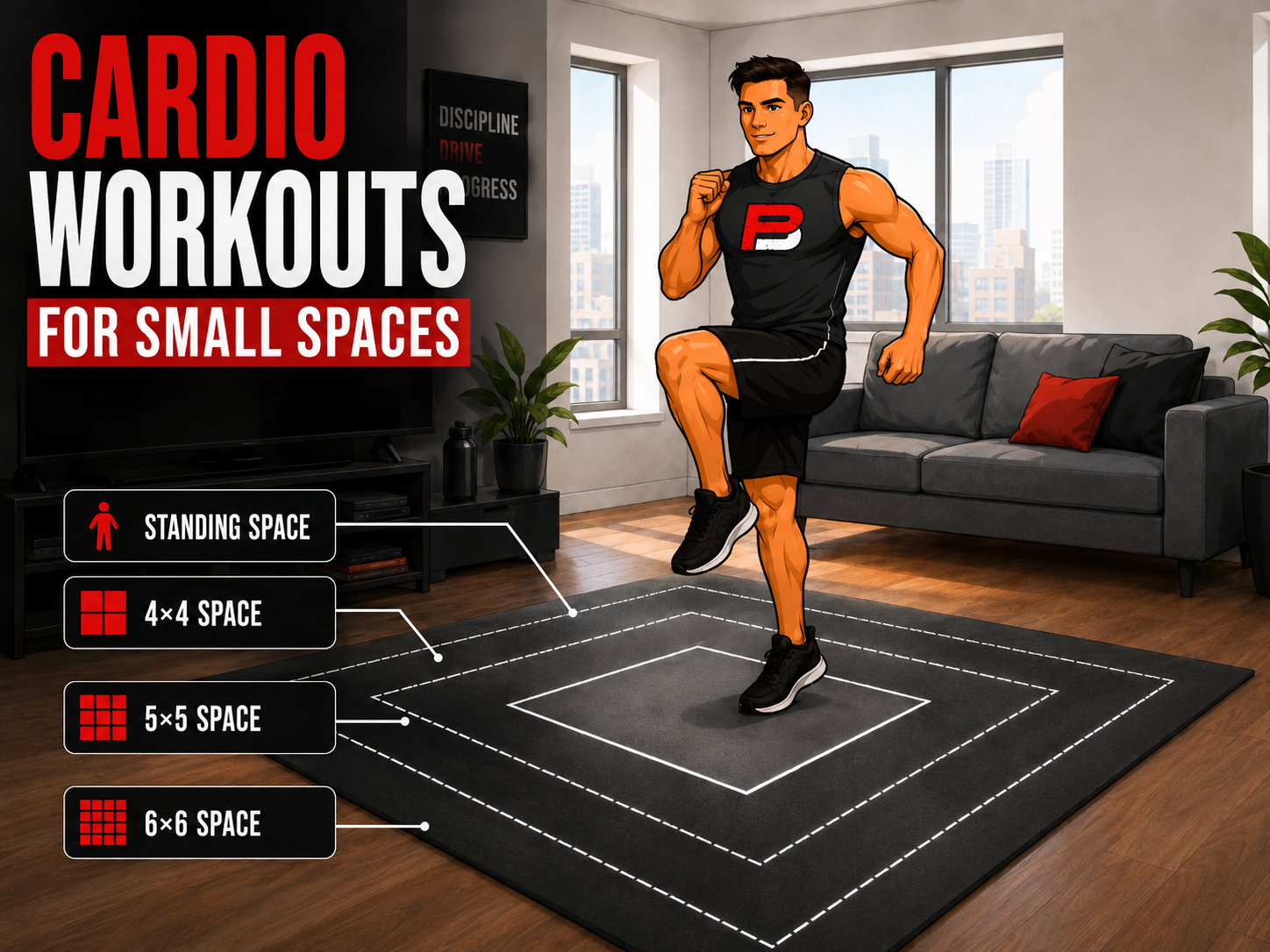
You do not need a big room, treadmill, garage gym, or wide-open living room to get a good cardio workout at home. I have worked out in tight spaces where I had just enough room to stand, step, turn, and move without bumping into furniture. That is exactly why I like building workouts around floor space first.
The real question is not, “What is the hardest cardio workout?” The better question is:
What cardio workout can I actually do in the space I have?
That is what this guide is built to answer.
Small-Space Workout Guide Map
- Start with the Small-Space Workout Routines hub
- Cardio workouts for small spaces
- Measure your workout space
- Compact equipment guides
Start with the Apartment Workout Starter System
Not sure where to begin? The Apartment Workout Starter System walks you through your space, noise level, beginner exercises, and first 7-day plan.
Start the Apartment Workout Starter System →Cardio Workouts for Small Spaces: The Simple Rule
When I test small-space cardio routines, I do not start with the exercise. I start with the floor. Before I decide on jumping jacks, mountain climbers, burpees, or high knees, I look at how much room I have to move safely.
For small-space cardio, I use four basic space levels:
| Available Space | Best Cardio Style | Good Exercise Choices |
|---|---|---|
| Standing-only space | Very compact cardio | Marching, knee lifts, heel digs, shadow boxing |
| About 4 ft x 4 ft | Tight-space cardio | Step jacks, fast feet, squat to reach, knee drives |
| About 5 ft x 5 ft | Mat-friendly cardio | Mountain climbers, plank jacks, step-back burpees |
| About 6 ft x 6 ft | Bigger-movement cardio | Jumping jacks, high knees, burpees, skater steps |
The smaller the space, the more controlled your workout needs to be. That does not mean easy. It just means smarter.
Before You Start: Check Your Workout Space
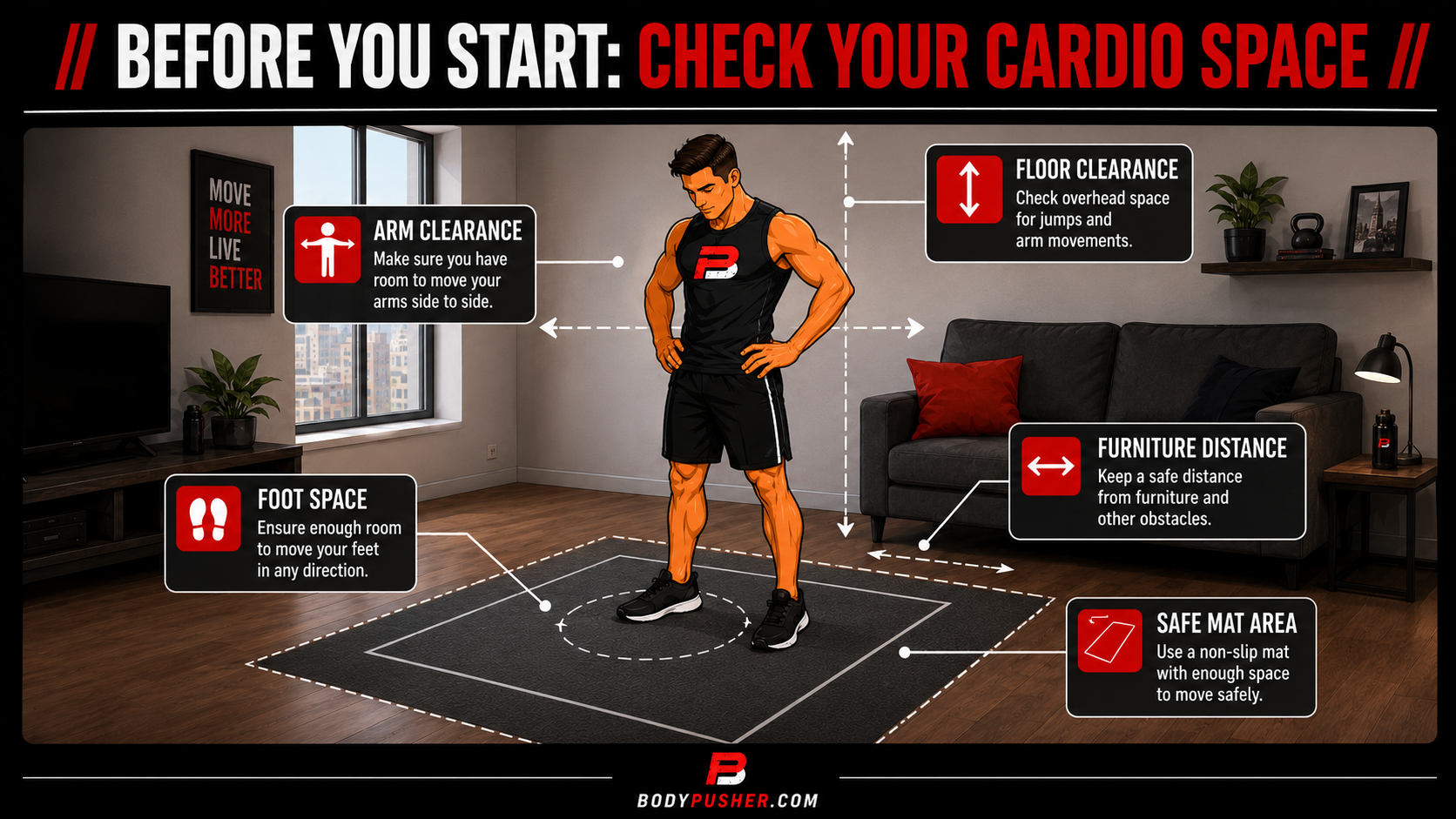
Before doing any small-space cardio workout, I like to do a quick space check. It takes less than a minute and helps you avoid kicking furniture, slipping on rugs, or choosing exercises that do not fit.
1. Clear the floor
Move shoes, bags, cords, laundry baskets, small tables, loose rugs, and anything else that could trip you up.
2. Step in every direction
Stand in the middle of your workout area. Step forward, backward, left, and right. If you can move without hitting anything, you have enough room for many compact cardio moves.
3. Check your arms
Raise your arms overhead and out to the sides. If your hands hit a wall, lamp, shelf, or ceiling fan, choose exercises with smaller arm movements.
4. Pick the right routine
Use the workout that matches your actual space, not the workout that looks the hardest online.
Can You Do Jumping Exercises in a Small Space?
Yes, you can do jumping exercises in a small space if you have enough room and safe footing. But jumping is not required.
I do not automatically remove jumping from small-space cardio. If you have enough side-to-side space, jumping jacks can work. If you have enough mat space, burpees can work. If you only have standing room, jumping is usually not the best choice.
| If You Have | Use These | Avoid These |
|---|---|---|
| Standing-only space | Marching, knee drives, shadow boxing | Burpees, skaters, wide jumping jacks |
| 4×4 space | Step jacks, fast feet, squat to reach | Big lateral jumps |
| 5×5 space | Mountain climbers, step-back burpees | Moves that make you travel too far |
| 6×6 space | Jumping jacks, high knees, burpees | Anything that feels cramped or unsafe |
If your main concern is noise, use no-jump cardio instead. If your main concern is space, choose the movement that fits your floor.
Best Cardio Exercises for Small Spaces
These are the cardio exercises I like most for tight areas because they do not require a lot of travel across the room.
| Exercise | Space Needed | Impact | Best Use |
|---|---|---|---|
| Marching in place | Standing-only | Low | Warm-ups, beginners, very tight spaces |
| Shadow boxing | Standing-only to 4×4 | Low | Upper-body cardio and standing workouts |
| Standing knee drives | Standing-only | Low | Compact cardio and core work |
| Step jacks | 4×4 | Low | Low-impact cardio in tight spaces |
| Fast feet | 4×4 | Medium | Short cardio bursts |
| Squat to reach | 4×4 | Low | Lower-body cardio |
| Mountain climbers | 5×5 or mat space | Medium | Core cardio and mat-based intervals |
| Step-back burpees | 5×5 or mat space | Medium | Controlled full-body cardio |
| Jumping jacks | 6×6 | Medium to high | Higher-energy cardio |
| Burpees | 6×6 | High | Advanced full-body cardio |
Standing-Only Cardio Workout
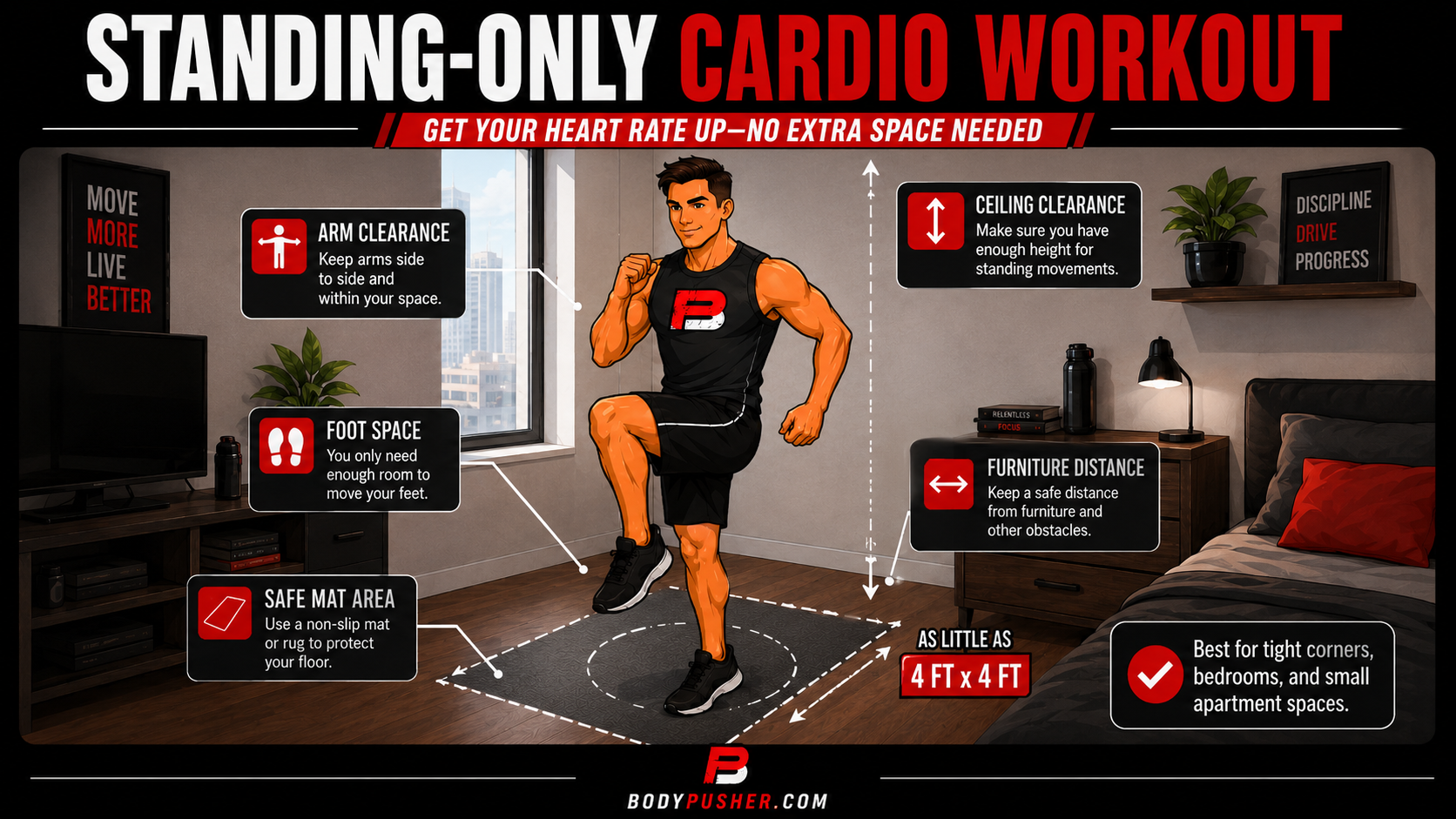
This is the workout I would use when space is extremely tight. You do not need a mat. You do not need to get on the floor. You just need enough room to stand and move your arms safely.
Best for: tiny rooms, corners, small bedrooms, tight apartments, low-impact cardio
How to do it
Do each exercise for 40 seconds, then rest for 20 seconds. Complete 3 rounds.
| Exercise | Time | Space Tip |
|---|---|---|
| Marching in place | 40 seconds | Keep your steps narrow |
| Shadow boxing | 40 seconds | Keep punches controlled |
| Standing knee drives | 40 seconds | Move straight forward and back |
| Heel digs | 40 seconds | Tap one heel forward at a time |
| Fast feet | 40 seconds | Keep your feet under your hips |
This is a simple routine, but it works because you keep moving. The goal is not to cover distance. The goal is to keep your heart rate up inside the space you have.
4×4 Cardio Workout
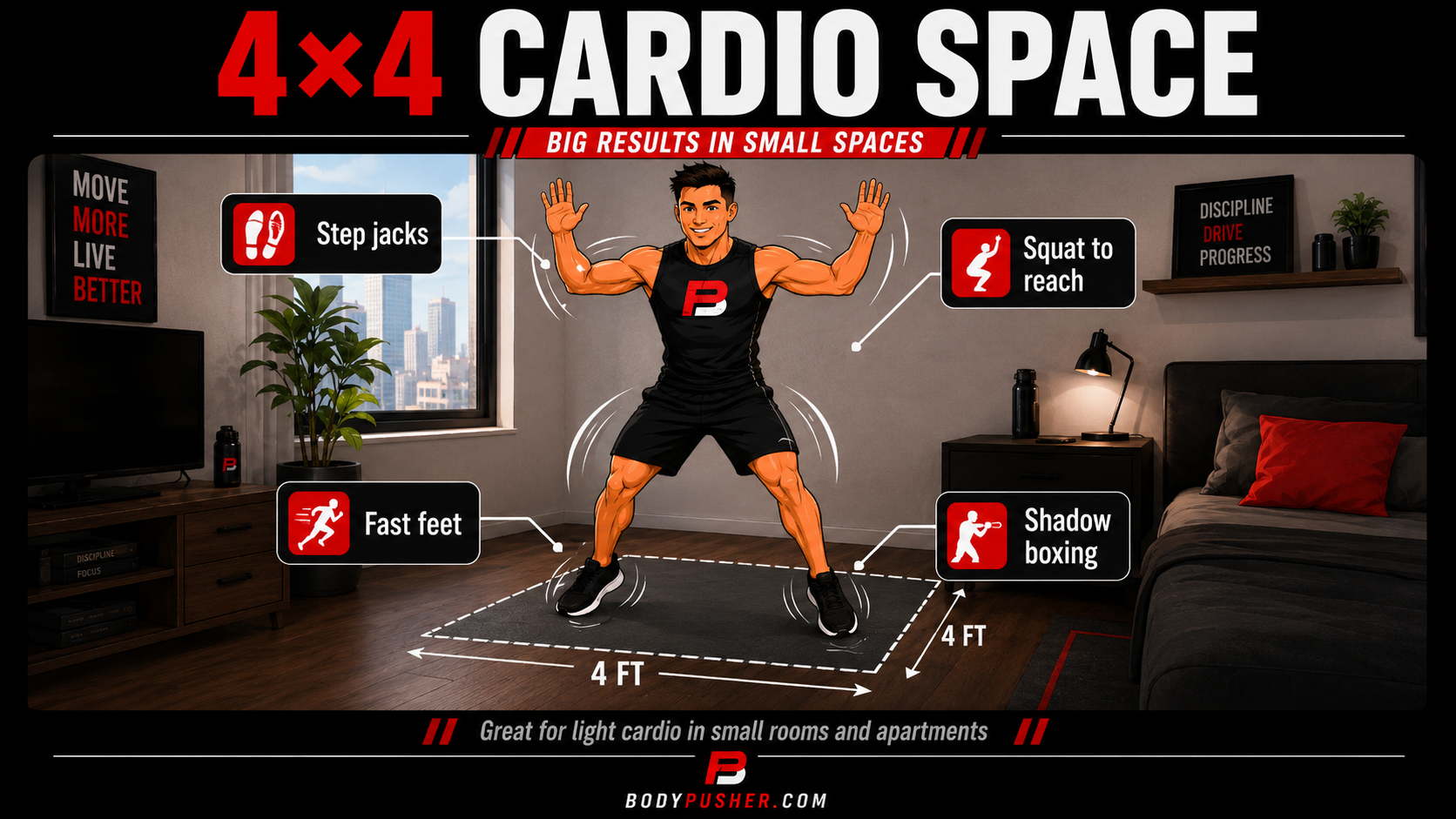
A 4-foot by 4-foot space gives you enough room for small stepping patterns, compact squats, and controlled cardio drills. This is one of the most realistic workout spaces for apartments.
Best for: small open floor spots, tight bedrooms, apartment corners, low-impact cardio
How to do it
Do each exercise for 45 seconds, then rest for 15 seconds. Complete 3 rounds.
| Exercise | Time | Why It Fits |
|---|---|---|
| Marching with arm drive | 45 seconds | Uses very little floor space |
| Step jacks | 45 seconds | Side step stays controlled |
| Squat to reach | 45 seconds | Mostly vertical movement |
| Standing knee drives | 45 seconds | No floor work needed |
| Fast feet | 45 seconds | Small, quick steps in place |
This is the routine I would choose when I have a small clear square of floor but not enough room for a mat-based workout.
5×5 Cardio Workout
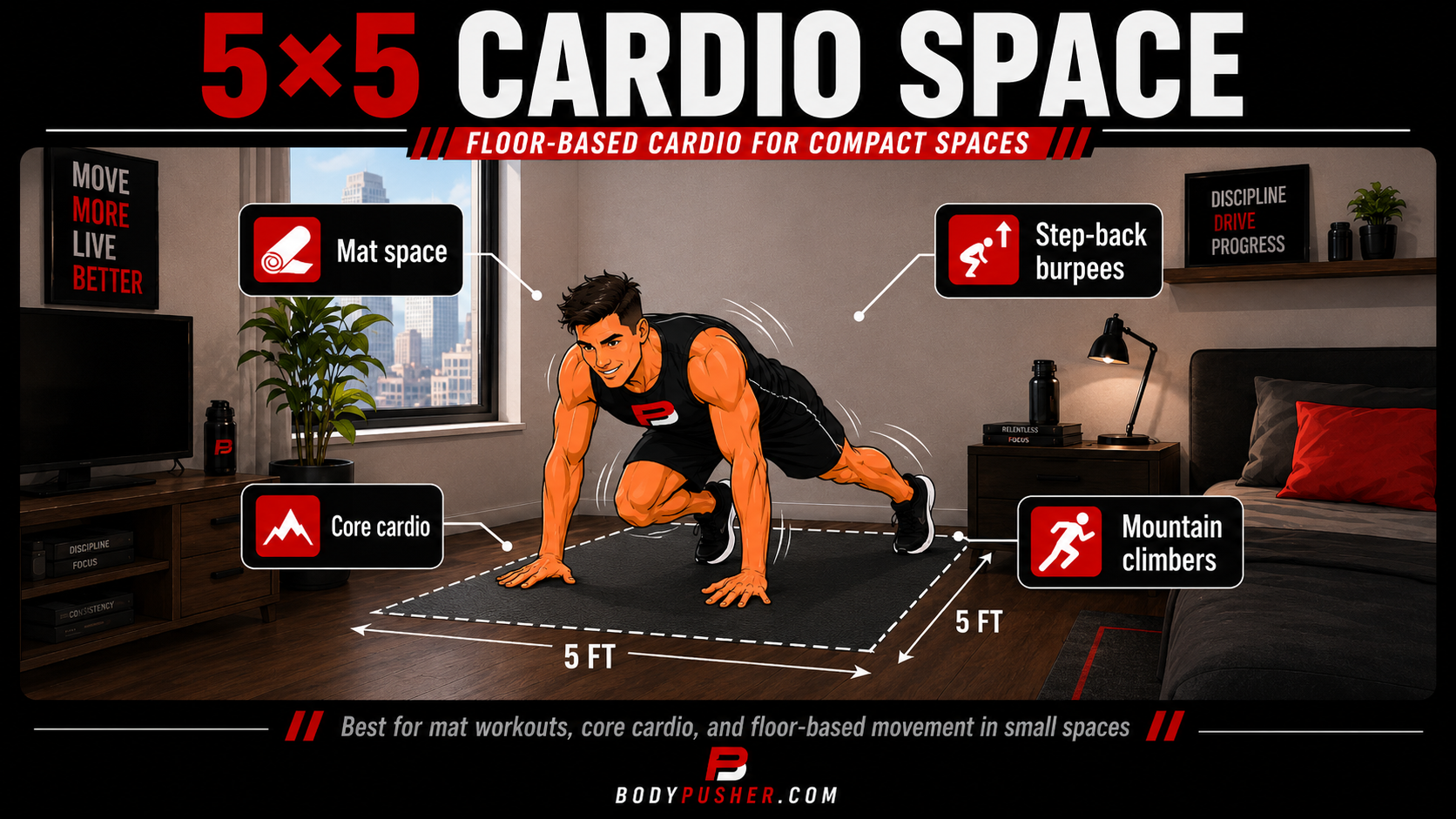
A 5-foot by 5-foot area usually gives you enough space for mat-based cardio. This opens up exercises like mountain climbers and step-back burpees.
Best for: mat space, bedrooms, living rooms, small apartments, bodyweight cardio
How to do it
Do each exercise for 40 seconds, then rest for 20 seconds. Complete 3 to 4 rounds.
| Exercise | Time | Space Tip |
|---|---|---|
| Step jacks | 40 seconds | Keep steps narrow |
| Mountain climbers | 40 seconds | Stay centered on the mat |
| Squat to reach | 40 seconds | Move up and down, not forward |
| Step-back burpees | 40 seconds | Step back instead of jumping back |
| Shadow boxing | 40 seconds | Control your punches |
This is a good middle-ground workout. It feels more intense than standing-only cardio, but it still does not require a large room.
6×6 Cardio Workout
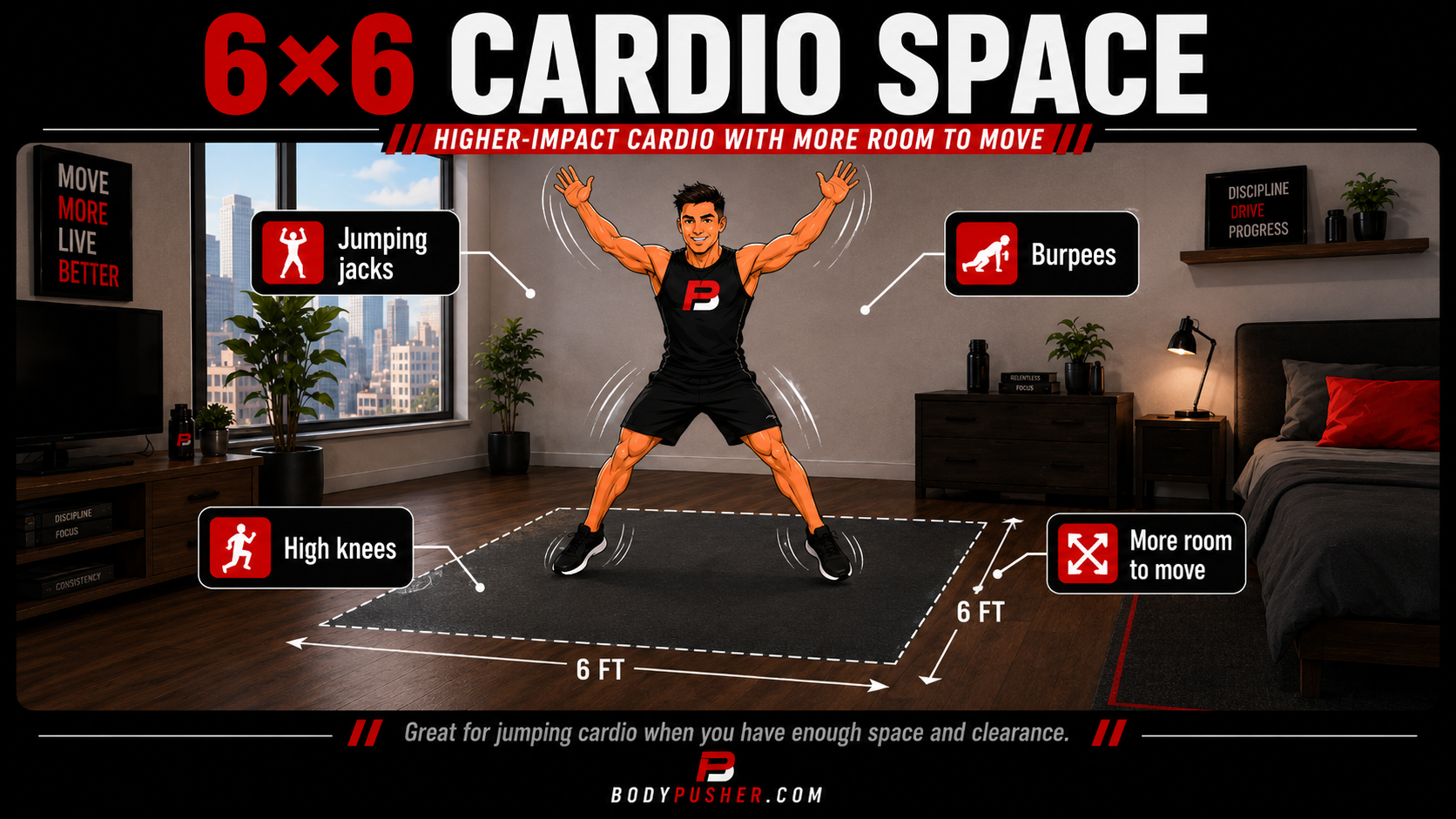
A 6-foot by 6-foot space gives you more freedom. You can add bigger movement, higher intensity, and optional jumping if your floor and joints can handle it.
Best for: more open apartment space, higher-intensity cardio, advanced bodyweight workouts
How to do it
Do each exercise for 45 seconds, then rest for 15 seconds. Complete 3 to 4 rounds.
| Exercise | Time | Lower-Impact Option |
|---|---|---|
| Jumping jacks | 45 seconds | Step jacks |
| High knees | 45 seconds | High-knee marching |
| Mountain climbers | 45 seconds | Slow mountain climbers |
| Burpees | 45 seconds | Step-back burpees |
| Fast feet | 45 seconds | Marching with arm drive |
This workout is more intense, but I would only use it if the space feels comfortable. If you feel cramped, go back to the 5×5 or 4×4 version.
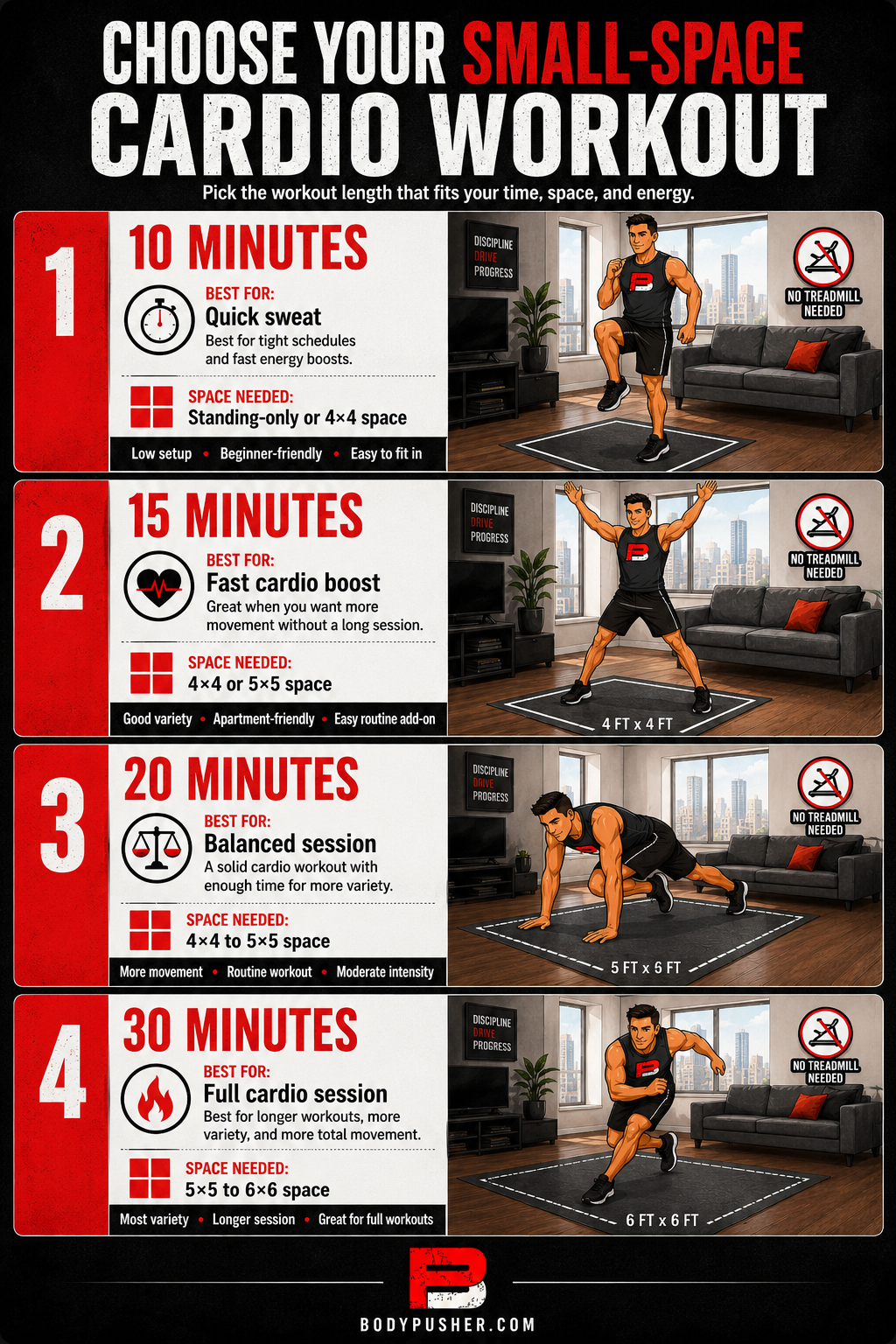
10-Minute Small-Space Cardio Workout
This is a quick routine for days when you want to move but do not want a long workout. I like this format because it is simple: five exercises, two rounds.
Do each exercise for 40 seconds. Rest for 20 seconds. Complete 2 rounds.
| Exercise | Time |
|---|---|
| Marching in place | 40 seconds |
| Step jacks | 40 seconds |
| Shadow boxing | 40 seconds |
| Squat to reach | 40 seconds |
| Fast feet | 40 seconds |
This is best for standing-only space or a 4×4 area.
15-Minute Small-Space Cardio Workout
This routine gives you more work without becoming complicated. It is a good everyday cardio option for small apartments.
Do each exercise for 45 seconds. Rest for 15 seconds. Complete 3 rounds.
| Exercise | Time |
|---|---|
| Marching with arm drive | 45 seconds |
| Step jacks | 45 seconds |
| Standing knee drives | 45 seconds |
| Fast feet | 45 seconds |
| Squat to reach | 45 seconds |
This works well in about a 4×4 space.
20-Minute Small-Space Cardio Workout
This is the one I would use when I want a real sweat but still need the workout to fit inside a small room.
Do each exercise for 40 seconds. Rest for 20 seconds. Complete 4 rounds.
| Exercise | Time |
|---|---|
| Step jacks | 40 seconds |
| Mountain climbers | 40 seconds |
| Shadow boxing | 40 seconds |
| Step-back burpees | 40 seconds |
| Fast feet | 40 seconds |
This is best if you have around 5×5 feet or enough room for a workout mat.
30-Minute Small-Space Cardio Workout
This is the longer option. I would not make every small-space cardio session this long, but it is useful when you want a complete workout with a warm-up, main circuit, and cooldown.
Warm-Up: 5 Minutes
| Exercise | Time |
|---|---|
| Easy marching | 1 minute |
| Step touches | 1 minute |
| Arm circles | 1 minute |
| Slow squat to reach | 1 minute |
| Light shadow boxing | 1 minute |
Main Circuit: 20 Minutes
Do each exercise for 45 seconds. Rest for 15 seconds. Complete 4 rounds.
| Exercise | Time |
|---|---|
| Step jacks | 45 seconds |
| High knees or high-knee marching | 45 seconds |
| Mountain climbers | 45 seconds |
| Step-back burpees | 45 seconds |
| Shadow boxing | 45 seconds |
Cooldown: 5 Minutes
| Movement | Time |
|---|---|
| Slow marching | 1 minute |
| Standing hamstring stretch | 1 minute |
| Quad stretch | 1 minute |
| Shoulder stretch | 1 minute |
| Deep breathing | 1 minute |
How to Make Small-Space Cardio Harder
You do not need more room to make a small-space cardio workout harder. You can increase the challenge by changing the pace, timing, or exercise version.
- Move faster while staying in control.
- Use longer work periods, such as 45 or 50 seconds instead of 30 seconds.
- Shorten your rest from 30 seconds to 15 seconds.
- Add bigger arm movement if you have room.
- Choose a higher-impact version only if your space and body allow it.
How to Make Small-Space Cardio Easier
If the workout feels too intense, make it easier before you quit. I would rather see someone finish a controlled workout than struggle through a routine that does not fit their body or space.
- Use marching instead of high knees.
- Use step jacks instead of jumping jacks.
- Use standing knee drives instead of mountain climbers.
- Use step-back burpees instead of regular burpees.
- Rest longer between exercises.
- Complete fewer rounds.
Small-Space Cardio Mistakes to Avoid
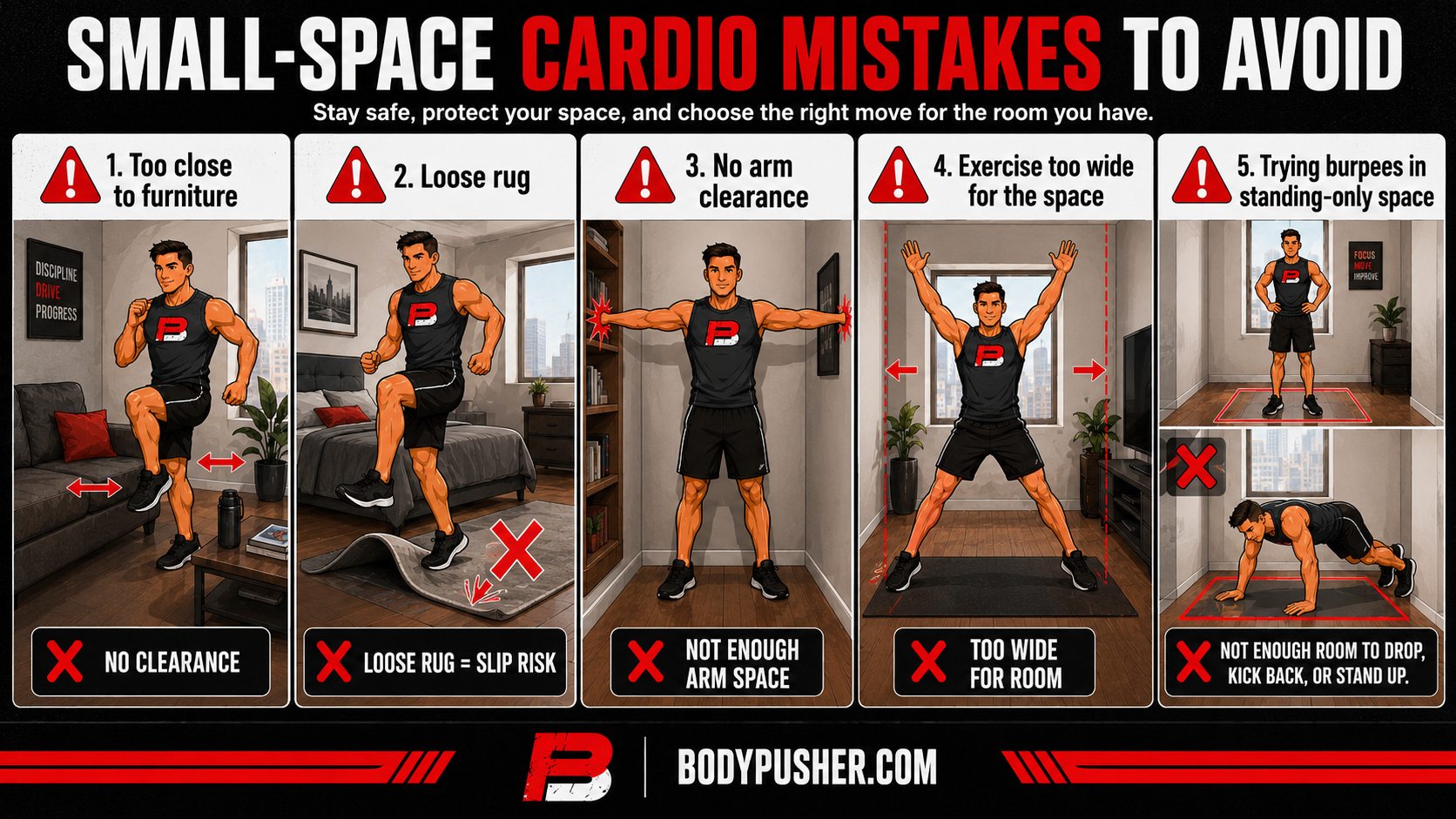
Choosing exercises that do not fit your space
If you have to keep stopping because you are hitting furniture, the exercise is not a good fit for that area.
Ignoring arm clearance
A workout can fit your feet but still fail because your arms hit walls, shelves, lamps, or ceiling fans.
Jumping before you have control
Jumping is not bad, but it should feel controlled. If you drift around the room, switch to a lower-impact version.
Doing every workout at full speed
Small-space cardio works better when you control your movement. Faster is not always better if your form falls apart.
Do You Need Equipment for Small-Space Cardio?
No, you do not need equipment for these workouts. Most small-space cardio routines can be done with bodyweight only.
That said, a few simple items can help:
- Exercise mat: helpful for mountain climbers, step-back burpees, and floor work.
- Interval timer: useful for 40/20 or 45/15 workouts.
- Supportive shoes: helpful if your floor is hard or slippery.
I would not start with bulky equipment for this page. The point is to get cardio done in the space you already have.
Weekly Small-Space Cardio Plan
If you want a simple weekly structure, use this plan. It gives you enough variety without making the week complicated.
| Day | Workout | Best Space |
|---|---|---|
| Monday | 15-minute small-space cardio | 4×4 |
| Tuesday | Standing-only cardio | Standing-only |
| Wednesday | Rest or light walking | Any space |
| Thursday | 20-minute small-space cardio | 5×5 |
| Friday | 10-minute quick cardio | Standing-only or 4×4 |
| Saturday | 6×6 cardio workout | 6×6 |
| Sunday | Rest, mobility, or stretching | Any space |
Start with the Apartment Workout Starter System
Not sure where to begin? The Apartment Workout Starter System walks you through your space, noise level, beginner exercises, and first 7-day plan.
Start the Apartment Workout Starter System →Small-Space Cardio FAQ
Can I get a good cardio workout in a small space?
Yes. You can get a good cardio workout in a small space by using exercises that keep you mostly in place, such as marching, step jacks, fast feet, shadow boxing, knee drives, mountain climbers, and step-back burpees.
What is the best cardio exercise for a small space?
The best cardio exercise depends on your available space. For standing-only space, I like marching, knee drives, and shadow boxing. For 4×4 space, step jacks and fast feet work well. For 5×5 space, mountain climbers and step-back burpees are good options.
How much space do I need for cardio at home?
You can start with standing-only space. More room gives you more exercise options, but you do not need a large room. A 4×4, 5×5, or 6×6 area can work well if you choose the right movements.
Can I do cardio without jumping?
Yes. Marching, step jacks, shadow boxing, standing knee drives, squat to reach, and step-back burpees can all raise your heart rate without jumping.
Can I do jumping jacks in a small space?
You can do jumping jacks in a small space if you have enough side-to-side clearance and safe footing. If they feel cramped, use step jacks instead.
What cardio can I do if I only have standing room?
If you only have standing room, use marching in place, heel digs, standing knee drives, shadow boxing, and small fast feet. Keep the movements narrow and controlled.
Is small-space cardio good for weight loss?
Small-space cardio can support weight loss when it helps you move consistently and fits into a realistic routine. The workout does not need to be fancy. It needs to be repeatable.
Recommended Reading
- How Much Space Is Needed to Exercise?
- No-Jumping Cardio Workout
- No-Jump HIIT Workouts for Apartments and Small Spaces
- Best Quiet Exercises for Apartments
- Beginner Apartment Workout
- Small Space Workout Routines
Final Thoughts
The best cardio workout for a small space is the one that fits your actual floor area. That is why I like choosing the routine by space first.
If you only have standing room, use the standing-only workout. If you have a small open area, use the 4×4 routine. If you have room for a mat, use the 5×5 workout. If you have more open space, try the 6×6 routine with higher-intensity options.
You do not need a big room to get your heart rate up. You just need the right exercises for the space you have.